Nostalgia (2020)
87cm × 117cm
Acrylic on canvas
Sold for RM15,000
A Collection of Paintings on the Malay College Kuala Kangsar
A Solo Exhibition by Haron Mokhtar
The artworks of The MCKK Series by Haron Mokhtar are paintings specially commissioned to celebrate and commemorate The Malay College Kuala Kangsar and are intended to be auctioned and sold to raise funds for The Malay College Kuala Kangsar by The MCKK Foundation.
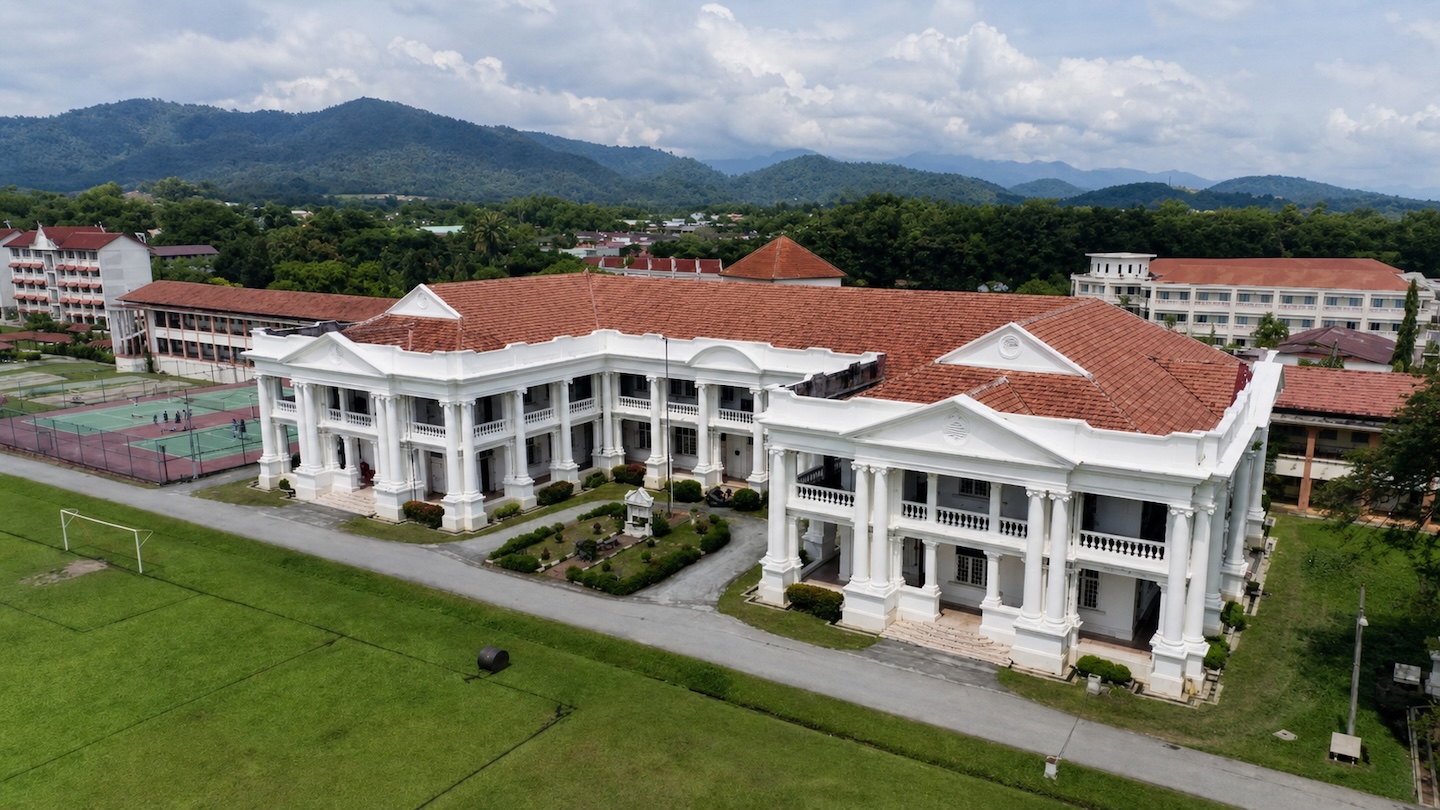
The MCKK Series is a collection of 49 distinctive and unique pieces, all centered around The Malay College Kuala Kangsar and Perak’s royal town, Kuala Kangsar. Painted in the distinctive and hallmark style of Haron Mokhtar’s architectural and cultural take on Malaysian scenes of days gone by, the MCKK Series features many of MCKK’s landmark buildings including the Big School, Prep School, New Academic Block and the old Kings’ Pavillion. These structures are depicted together with typical scenes from MCKK that the school’s students and Old Boys would intuitively recognise, ranging from sporting activities, cheering at games, balik kampung, to the infamous detention class punishment.
Familiar Kuala Kangsar iconic buildings and streetscapes are also featured, including Masjid Ubudiah, Masjid Ridzwaniah, Istana Iskandariah, the Post Office, Kuala Kangsar railway station and the Old Boy’s favourite Hainanese coffee shop, Yut Loy.
3rd October to 18th October 2026
KL City Art Gallery, Publika Kuala Lumpur
All the original artworks of the MCKK Series have been specially commissioned by The MCKK Foundation and are intended to be sold as part of the MCKK Fundraising Initiative. To bid and purchase for any of the paintings from the exhibition, please refer to the online link provided or visit the exhibition between 3rd October to 18th October 2026.
A catalogue of all the paintings in The MCKK Series has also been published specially for the exhibition and is available for sale. This catalogue is intended to preserve and document the images of The MCKK Series, making it accessible to all.
The rights and copyright for the artworks have been assigned to The MCKK Foundation, with all proceeds from the sale of the artworks and catalogues going to The MCKK Foundation in support of The Malay College Kuala Kangsar
Haron Mokhtar was born in Sungai Besar, Selangor in 1963. Cikgu Haron, as he is fondly known by many of his admirers, graduated with a BA in Fine Arts from UiTM in 1987. In 1988, he obtained his Diploma in Art Education, also from UiTM, and embarked on a long and distinguished career as an educator and artist. He began his teaching career in Sarawak, having taught in Sarikei and Sibu and later returned to his home state of Selangor to teach in Klang and Sabak Bernam.
From 1998 until his retirement in 2021, he was the Head of Humanities at SMK Ungku Aziz in Sabak Bernam. Although retired from teaching, Cikgu Haron continues to paint, drawing inspiration from his extensive travels across Malaysia and to far flung locations such as destinations on the ancient Silk Route in China, Russia, Mongolia, Kazakhstan and Uzbekistan. He frequently travels to draw and paint, taking him to distant countries such as Finland and Saudi Arabia, and closer to home he is a frequent visitor to Indonesia, Thailand and Vietnam.
Cikgu Haron is married to Puan Shamsiah Hamjah, and they have four children and five grandchildren. He is an active life member of the Pertubuhan Banjar Malaysia, where he is frequently found involved in its activities as a designer for exhibitions on the economic, political and social life of the Banjar community in Malaysia.
He gained early recognition as an artist when he won the Major Award in the Young Contemporary Artist category (awarded by the National Art Gallery) in 1987. His other awards include Second Prize, Landscape Selangor competition (Shah Alam Art Gallery, 2002), Consolation Prize, Historical Incidents competition (National Art Gallery, 2005) and Second Prize, Merdeka competition (Mekar Citra - Shah Alam Art Gallery, 2010). In 2014 Cikgu Haron was bestowed the ‘Setia Mahkota Selangor’ award by HRH Sultan of Selangor, in recognition of his contributions to the arts and education.
Haron Mokhtar has held eight solo exhibitions since his first in 1995. His works are widely collected by individuals as well as corporate and institutional collectors. Notably amongst his main collectors include HRH Sultan of Selangor and many of Haron Mokhtar’s distinctive works are also on display at Malaysian foreign missions abroad.
Cikgu Haron now paints from his studio and gallery, Galeri Merah Teratak Anak Amas, located amidst the scenic paddy fields of Sungai Besar, Selangor.
In a town nestled by the Perak River, stands a school whose reputation has echoed through generations. The Malay College Kuala Kangsar, known as MCKK or simply Kolet, is more than a century old, yet its spirit remains etched in the minds and hearts of those who once passed through its hallowed halls. Products of this school proudly call themselves budak Kolet. To many, it is just a school. But to those who know its soul, it is a symbol of national hope, a heritage of honour and a forge where boys became men destined to lead.
Dubbed the “Eton of the East”, MCKK was founded in 1905 not merely to educate, but to cultivate leadership among the sons of the Malay elite. Known at first as the Malay Residential School, the College was built in the royal town of Kuala Kangsar. Its founding was guided by a vision to develop a class of educated Malays who could take on administrative and leadership roles in the Federated Malay States. Over time, its doors and values opened wider. It became a more inclusive institution, drawing students from various backgrounds who shared a common drive - to excel and to serve. Today, it is the only school in the country that is under the patronage of the Conference of Rulers. The Sultan of Perak, His Royal Highness Sultan Nazrin Muizzuddin Shah ibni Almarhum Sultan Azlan Muhibbuddin Shah Al-Maghfur-Lah is currently the Royal Patron of the MCKK Board of Governors.
In 2005, MCKK marked its centenary with a spectacle that reached deep into the well of its own history. A regal procession of elephants moved with quiet majesty across the college grounds, evoking the royal traditions and noble beginnings upon which the institution was founded. It was more than pageantry; it was a living symbol of continuity - a reminder that Kolet’s story is inseparable from the story of the nation itself. The elephants did not merely parade; they carried with them a century of legacy, pride, and the unbroken spirit of a school that has shaped generations of leaders.
87cm × 117cm
Acrylic on canvas
Sold for RM15,000
147cm × 122cm
Acrylic on canvas
Sold for RM9,000
60cm × 75cm
Acrylic on canvas
RM3,000
Available
for Sale
147cm × 122cm
Acrylic on canvas
Sold for RM13,000
80cm × 119cm
Acrylic on canvas
Sold for RM8,888.88
60cm × 75cm
Acrylic on canvas
Sold for RM3,200
45cm × 60cm
Acrylic on canvas
Sold for RM2,000
45cm × 60cm
Acrylic on canvas
Sold for RM2,000
88cm × 118cm
Acrylic on canvas
Sold for RM6,500
100cm × 120cm
Acrylic on canvas
RM7,000
Available
for Sale
88cm × 118cm
Acrylic on canvas
Sold for RM15,000
The traditions of MCKK, some forgotten by time, but forever remembered by its students, were never merely quaint school customs. They were instruments of character-building, rooted in the school’s deeper purpose: to shape boys into men of integrity, resilience and service. The games, the rules, the rituals, they all had meaning. The detention class and punishments, the flattening of tennis courts with steel rollers, and the collective pride on the rugby field taught discipline, unity and respect.
Friday Prayers and the Big Tree: The ancient Big Tree under which boys gathered before Friday prayers, the quiet walks along the covered walkway, the whispered jokes and shared secrets, these were not incidental moments; they were the rites of passage in a school that took character formation seriously. MCKK never set out simply to produce clever boys. It aimed to nurture good men. Men who would uphold values, serve society, and carry with them a quiet strength rooted in humility and solidarity.
A Citadel of Malay Tradition: MCKK is unapologetically Malay at its core, yet expansive in its vision and modern in its outlook. Tradition was not an affectation but a lived reality. Each evening, boys donned their Baju Melayu and songkok as naturally as they wore their school ties by day; on Fridays, the samping completed a regalia that spoke of heritage, discipline, and quiet pride. These were not mere uniforms, but daily affirmations of identity and continuity.
Early Lessons in Responsibility: From the moment they stepped into Prep School, budak Kolet were entrusted with lessons in financial responsibility alongside the rigors of academic and personal growth. Away from the familiarity of home, they quickly learned to navigate not just the emotional challenges of independence, but also the practical demands of managing their own money. In learning to plan, prioritise, and spend wisely, they were not merely handling money; they were cultivating discipline, foresight, and self-reliance; skills as essential to life as any lesson taught in the classroom.
Balik Kampung: Tastes of Home: For mid-term holidays, budak Kolet would board the train heading home, eagerly anticipating a brief escape from the relentless glare of prefects and duty masters enforcing rules often seen as petty and unnecessary. For most, it was simply a return to familiar comforts.
Cheering at Games: Pride and passion in sports were never confined to the players on the field. They surged through the sidelines, where the entire budak Kolet turned up in full voice, cheering the school team with gusto and unrestrained loyalty. In rhythmic unison, the cheering songs rang out - raw, thunderous, and unmistakably Kolet. This collective roar bound players and supporters into a single force, lifting tired legs, stiffening resolve, and reminding every opponent that Kolet spirit was not worn by the players on the field alone, but also carried by an entire brotherhood on the sidelines.
107cm × 122cm
Acrylic on canvas
Sold for RM22,000
60cm × 80cm
Acrylic on canvas
Sold for RM3,000
100cm × 120cm
Acrylic on canvas
Sold for RM9,000
88cm × 118cm
Acrylic on canvas
Sold for RM10,000
87cm × 117cm
Acrylic on canvas
Sold for RM6,500
45cm × 60cm
Acrylic on canvas
Sold for RM2,000
107cm × 122cm
Acrylic on canvas
Sold for RM8,000
45cm × 60cm
Acrylic on canvas
Sold for RM5,500
56cm × 76cm
Acrylic on canvas
RM2,500
Available
for Sale
107cm × 122cm
Acrylic on canvas
Sold for RM15,000
87cm × 117cm
Acrylic on canvas
Sold for RM6,500
Where Brotherhood Took Root: In the quiet lanes of Kuala Kangsar, congregating beneath the rain trees, eating laksa and mee Bandung by the river’s bend, Friday prayers at Masjid Ridzwaniah, and within the corridors of the Big School – budak Kolet learned what it meant to grow up together far from home. Every hardship faced, every laughter shared, and every new experience etched itself into them, shaping friendships that time could not erode.
Learning by Example: The Enduring Influence of Seniors: In Kolet, respect for seniors is woven into the very fabric of daily life. Juniors do not just admire those who have spent more years in the hostel - they watch, learn, and emulate their habits, their discipline, and their strategies for excelling in both academics and sports. Seniors naturally become the first role models, guiding through example rather than instruction. This culture of deference, observation, and quiet mentorship has long been a hallmark of Kolet life, enduring even before the tradition of long trousers marked the transition to seniority.
Beyond the Scoreboard: On MCKK’s fields and courts, budak Kolet learned early that strength was never measured by muscle alone, but by the harmony of hearts moving with a single purpose. Victory instilled pride and lifted their spirits, yet defeat proved the sterner teacher, cultivating grace, humility and the quiet resolve to rise again. Long after the scoreboards were reset and the crowds dispersed, what remained was the enduring fellowship of boys who had tested themselves together, and in doing so, found in one another a loyalty that no victory or defeat could ever diminish.
Rugby and the Making of Men: Rugby is more than just a game; it is a demanding school of character. It teaches discipline, resilience, and respect - values that carry naturally into adult working life. Success on the field depends on teamwork and trust, on understanding strategy as much as physical strength, and on mastering multiple skill sets under pressure. In shaping both body and mind, rugby prepares its players not just to win matches, but to face life with grit, judgment, and integrity.
From Discipline to Duty: The journey to leadership was shaped not only in classrooms, but in the quiet discipline of consequence. Every punishment borne for rules we bent, as spirited boys often do, served as a gentle reminder that character is chiselled by accountability. From schoolboys chasing balls across open fields and preparing for examinations at their desks, we grew into men who understood that hard work, strengthened by teamwork, forms the true pulse of leadership. In time, those same boys came to carry the weight of responsibility with steadier hands and humbler hearts.
75cm × 75cm
Acrylic on canvas
Sold for RM4,500
147cm × 122cm
Acrylic on canvas
Sold for RM10,000
80cm × 120cm
Acrylic on canvas
Sold for RM8,000
60cm × 80cm
Acrylic on canvas
RM3,000
Available
for Sale
88cm × 118cm
Acrylic on canvas
Sold for RM7,000
88cm × 118cm
Acrylic on canvas
RM6,500
Available
for Sale
107cm × 122cm
Acrylic on canvas
Sold for RM10,000
88cm × 118cm
Acrylic on canvas
Sold for RM7,000
88cm × 118cm
Acrylic on canvas
Sold for RM6,500
100cm × 120cm
Acrylic on canvas
Sold for RM9,000
80cm × 120cm
Acrylic on canvas
Sold for RM6,000
To the students of MCKK, Kuala Kangsar is a world within a town, a source of quiet welcoming familiarity that many have made it their second hometown. To those who studied there, it was a sanctuary, a training ground, and a cradle of identity. This royal town of Perak held a distinguished place in Malaysia’s history, not only as the seat of the Perak Sultanate, but also as the birthplace of MCKK. Its establishment was fully supported by the Sultan of Perak, Sultan Idris Murshidul Azam Shah I. The selection of Kuala Kangsar as the location for MCKK was significant. As the royal town, it symbolised the fusion of traditional Malay heritage with modern education. The town itself is rich in history and culture, featuring landmarks such as the Ubudiah Mosque, Istana Iskandariah, and the Perak Royal Museum.
Kuala Kangsar itself was a vital part of the MCKK experience. The weekly visits to town, the comic and book shops - Swami for Beano and Dandy and Chung Wah for stationery and art supplies; the popular restaurants - Restoran Yut Loy for the soft fluffy steamed bun ‘paus’, Queens Restaurant for a delightful medley of icy cold, crunchy barley, longan, lai chi kang, Panjang Stall for hot spicy pasembor and air tebu, a humble, unnamed Punjabi stall near the bus station for chapati and a stroll along the Sungai Perak for laksa or mee rebus - all contributed to the texture of student life. Yet, once back inside the College gates, the boys entered another world, a world of timeless rules and brotherhood. For many budak Kolet, these memories are etched as vividly as the subjects they studied there. It was not just what they learned from books, it was what they learned about themselves that stayed with them.
Over the years, Kuala Kangsar and budak Kolet forged a bond - an enduring relationship that transcended mere school loyalty. It became a shared memory woven into the very fabric of the quaint royal town of Perak; etched into the stones of the clock tower, whispered through the corridors of the old post office, and carried in the fading glow of its cinemas and riverside food outlets. In the stationary stalls and humble sundry shops where boys lingered mid-week to replenish needs for bathroom and personal locker. The town proudly received them, watched them grow, and in time, claimed them as its own. Budak Kolet knew Kuala Kangsar was never just a setting to their schooling, but a gentle custodian of their youth. Long after they departed its leafy avenues and river bends, the town remained imprinted upon their hearts as not merely a place once inhabited, but a companion in their becoming, forever binding budak Kolet to the royal town that helped raise them.
107cm × 122cm
Acrylic on canvas
Sold for RM8,500
100cm × 120cm
Acrylic on canvas
Sold for RM7,500
88cm × 118cm
Acrylic on canvas
Sold for RM8,500
60cm × 75cm
Acrylic on canvas
Sold for RM3,000
70cm × 91cm
Acrylic on canvas
Sold for RM5,000
51cm × 64cm
Acrylic on canvas
Sold for RM2,500
45cm × 60cm
Acrylic on canvas
Sold for RM4,000
80cm × 60cm
Acrylic on canvas
Sold for RM5,000
86cm × 147cm
Acrylic on canvas
Sold for RM9,500
76cm × 92cm
Acrylic on canvas
Sold for RM5,000
71cm × 91cm
Acrylic on canvas
Sold for RM5,000
75cm × 75cm
Acrylic on canvas
Sold for RM4,000
45cm × 60cm
Acrylic on canvas
Sold for RM2,000
107cm × 122cm
Acrylic on canvas
Sold for RM8,500
79cm × 109cm
Acrylic on canvas
Sold for RM10,000
Sold for
NOT FOR SALE